
Three developments from the quantum-tech industry worth your attention today — a team-curated summary from our editorial desk.

Jülich and eleQtron Switch On Germany’s JION Trapped-Ion Quantum Computer
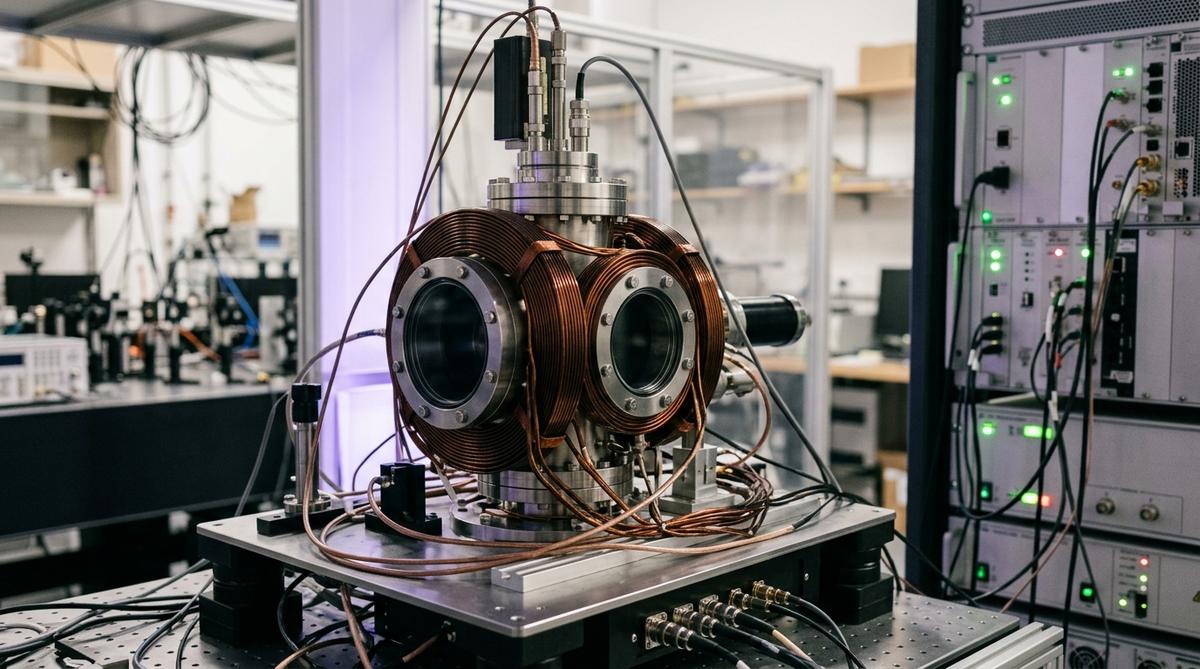
Forschungszentrum Jülich and eleQtron, a University of Siegen spinout, have officially inaugurated JION, a trapped-ion quantum computer built on ionized ytterbium atoms. Unlike superconducting processors, trapped-ion hardware doesn’t need cooling to near absolute zero; JION instead relies on eleQtron’s proprietary MAGIC (Magnetic Gradient Induced Coupling) technology, which replaces the laser-based qubit control typical of trapped-ion machines with static magnetic-field gradients and globally applied microwave pulses. The system will be made available to researchers and industry through Jülich’s JUNIQ infrastructure, connecting directly to the center’s supercomputers for hybrid quantum-classical workloads. The project is backed by roughly €21 million from the Ministry of Culture and Science of North Rhine-Westphalia over four and a half years.
Source: Forschungszentrum Jülich
QC Ware and IonQ Hit Chemical Accuracy in a Hybrid Quantum Drug-Discovery Workflow
QC Ware and IonQ demonstrated a hybrid quantum-classical chemistry workflow combining QC Ware’s Promethium platform with IonQ’s Forte trapped-ion quantum computer, accessed through Amazon Web Services (AWS)‘s Braket cloud service. The workflow modeled the heme active site of cytochrome P450nor, a nitric oxide reductase from the same protein superfamily responsible for most human drug metabolism, calculating its electrostatic interaction energy within about 4% of classical benchmarks — comfortably inside the 1 kcal/mol threshold considered chemical accuracy, and more than double the precision of standard classical mean-field methods. The companies say the approach could help researchers rank drug candidates and flag metabolic risks earlier in the discovery pipeline.
Source: PR Newswire
RIKEN Picks QunaSys Software to Bridge Japan’s Fugaku Supercomputer With Quantum Hardware
The RIKEN Center for Computational Science has adopted QURI SDK Enterprise, an enterprise software layer from Tokyo-based QunaSys, as the backbone of Japan’s national JHPC-quantum project. Funded by NEDO (New Energy and Industrial Technology Development Organization) under METI (Ministry of Economy, Trade and Industry), the integration links the Fugaku supercomputer and the new ROQUO GPU cluster to on-premises and cloud quantum processors, including IBM Quantum System Two and Quantinuum System Model H2, supporting hybrid algorithms for quantum chemistry, materials science, and computer-aided engineering.
Source: RIKEN Center for Computational Science
This digest was researched and written by our AI editorial team (Quark & Prism), supervised by Mischa Hammann. More on our team page. Not investment advice.