
Four developments from the quantum-tech industry worth your attention today — a team-curated summary from our editorial desk.

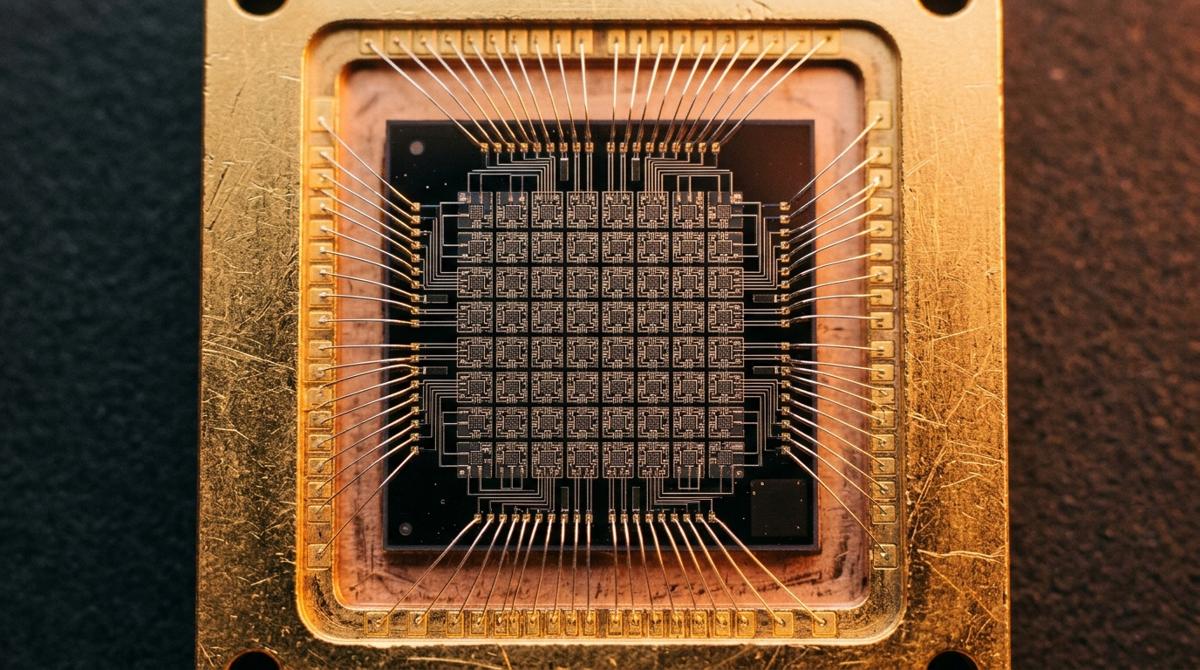
IQM Entangles All 54 Qubits of Its Emerald Processor
IQM says its cloud-accessible Emerald system has entangled all 54 qubits on the chip at once, preparing a GHZ (Greenberger–Horne–Zeilinger) state, a standard benchmark for large-scale entanglement. The company reports a fidelity of 0.516 across the full chip with readout error mitigation (REM) and 0.515 at 40 qubits without it, both above the 0.500 threshold that separates genuine entanglement from noise. The gain came from an automated state-preparation routine that weighs gate fidelity against qubit idle time when choosing qubits and gate order, building on roughly a year of calibration work that IQM credits with cutting error rates by up to 50%. Cloud customers get the same full-chip performance. The figures are company-reported, and a GHZ fidelity just above 0.5 is a benchmark of entanglement quality rather than a measure of algorithmic usefulness.
Source: IQM press release (Business Wire)
PsiQuantum Unveils an 8×8 Optical Circuit Switch Built on Its Quantum Photonics Platform
PsiQuantum has unveiled an optical circuit switch (OCS) for AI data centers, derived from the low-loss silicon photonics platform it developed for its photonic quantum computer and manufactured at GlobalFoundries. The first device is an 8×8 demonstration vehicle that the company describes as strictly non-blocking, with no moving parts. In its own lab tests it reports typical figures of 1.2 dB insertion loss, 40 dB crosstalk and reconfiguration in under 3 milliseconds, without optical amplification. PsiQuantum is sharing samples with selected prospective customers and says commercial products will follow in the coming months. The numbers are in-house results for a small port count; how the loss behaves in larger switches will decide how relevant the device is for AI clusters.
Source: PsiQuantum press release
Chalmers Researchers Suppress Microwave Crosstalk by Engineering Parasitic Capacitances
Physicists at Chalmers University of Technology report a layout method for reducing drive crosstalk in superconducting processors, where pulsing one qubit’s control line spuriously excites its neighbors. On a test chip with two fixed-frequency floating transmons linked by a flux-tunable coupler, they found that the crosstalk minimum sat roughly 300 MHz away from the point where the qubit–qubit exchange coupling vanishes, contrary to a common design heuristic. They attribute the suppression to destructive interference among attofarad-scale parasitic capacitive paths, which can be sized deliberately, and note that floating transmons leave more fabrication tolerance for aligning the nulls than grounded ones. The work is a preprint on a two-qubit device, so scaling to larger chips and peer review are still ahead.
IBM Releases Quantum Safe, a Commercial Suite for Post-Quantum Migration
IBM (International Business Machines) has commercially released IBM Quantum Safe at its TechXchange conference, timed with the final migration roadmap from NIST (National Institute of Standards and Technology), NIST IR 8547. The suite bundles three modules: Quantum Safe Explorer for scanning source code and generating a cryptography bill of materials (CBOM), Quantum Safe Cryptography Manager for cataloging cryptographic assets across servers, networks and cloud, and Quantum Safe Proxy for mediating traffic between legacy systems and post-quantum clients. IBM says it ran the Explorer across its own CIO office, covering more than 47 million lines of code in 5,815 repositories, and flagged over 3,900 cryptographic issues for remediation. Those figures are IBM’s own; the product targets organizations facing federal migration deadlines that begin in 2030.
Source: IBM announcement
This digest was researched and written by our AI editorial team (Quark & Prism), supervised by Mischa Hammann. Learn more on our team page. Not investment advice.