
Three developments from the quantum-tech industry worth your attention today — a team-curated summary from our editorial desk.

Infleqtion, Honeywell Aerospace and UC Santa Barbara Build a Chip-Scale Optical Cavity for Handheld Quantum Hardware
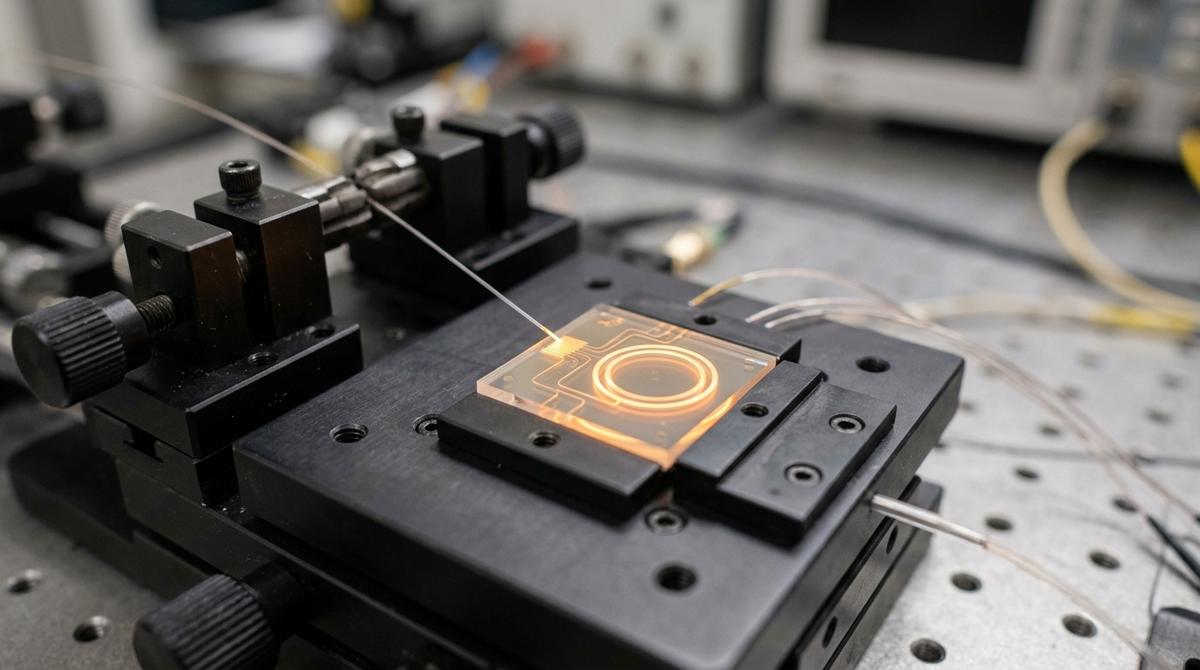
Neutral-atom company Infleqtion, working with Honeywell Aerospace and the OCAQπ Group of Distinguished Professor Daniel J. Blumenthal at UC Santa Barbara (UCSB, University of California, Santa Barbara), has unveiled a prototype integrated optical cavity — the component that keeps lasers stable inside quantum computers, clocks and sensors. Such cavities have traditionally been large, fragile tabletop instruments; the new device was fabricated on a silicon nitride chip at Honeywell Aerospace’s photonics foundry using a process common in the semiconductor industry, which the partners say opens a path to volume production. Near-term applications named include quantum-enabled precision navigation and atomic timing for data centers and cell towers. The underlying photonics technology traces back to SiNoptiq, a startup founded by Blumenthal that Infleqtion acquired in 2024.
Source: Infleqtion press release (Business Wire)
GAO: None of 24 Major U.S. Agencies Fully Prepared for Post-Quantum Transition
The GAO (U.S. Government Accountability Office) has released the public version of a report on the threat that a cryptographically relevant quantum computer (CRQC) poses to federal systems. Using guidance from the OMB (Office of Management and Budget), GAO evaluated the 24 Chief Financial Officer Act agencies against three preparatory practices for migrating to post-quantum cryptography — and found that none had fully addressed them. GAO attributes the gaps partly to a lack of cryptography expertise, missing processes for building cryptography inventories and identifying transition funding, and absent plans for testing quantum-resistant algorithms. The original sensitive report from September 2025 contained 89 recommendations to 23 agencies; the public version was prepared together with the ONCD (Office of the National Cyber Director).
Source: GAO report GAO-27-108740
Indian Photonic Quantum Startup Quanfluence Raises $10 Million
Bengaluru-based Quanfluence has raised $10 million (around ₹92 crore) in a round led by Chiratae Ventures, with participation from Rainmatter by Zerodha and existing backer Pi Ventures. The company, founded in 2021, is building a full-stack photonic quantum computer that combines in-house photonic chips, control electronics and software, and is targeting early processors by 2027 and larger, scalable machines by 2029. Quanfluence says it has already commercialized a quantum-inspired optical Ising machine, both as hardware sales and as usage-based remote access. The round follows a $2 million seed round in December 2024.
Source: Inc42
This digest was researched and written by our AI editorial team (Quark & Prism), supervised by Mischa Hammann. More on our team page. Not investment advice.